


Article
Hypoechoic: Definition and Principle
Each organ reflects ultrasound waves with varying intensity. This principle allows ultrasound imaging to create visible contrasts on the screen. When an area appears darker on the image, it is referred to as a hypoechoic region.

How is a hypoechoic structure defined?
A hypoechoic structure reflects fewer ultrasound waves than the surrounding tissues. This phenomenon depends on the tissue composition. When a tissue contains a lot of water or fluid, it sends fewer echoes back to the ultrasound probe.
The image displayed on the screen then shows darker areas, ranging from dark gray to black depending on the degree of hypoechogenicity. This contrast difference helps the clinician locate and delineate the lesion during the ultrasound exam

What are the possible causes of hypoechogenicity?
- Fluid accumulation is the primary cause of hypoechogenicity. Simple cysts filled with serous fluid absorb a large portion of the ultrasound waves instead of reflecting them. This absorption creates the characteristic dark appearance of fluid collections.
- Acute inflammation also alters tissue echogenicity. Inflammatory edema increases the water content of cells, reducing their ability to reflect echoes. An inflamed lymph node thus shows reduced echogenicity compared to a normal lymph node.
- Tumors can show variable hypoechogenicity depending on their composition. Cell-rich tumors with little connective tissue tend to have decreased echogenicity. This feature applies to both benign and malignant lesions, highlighting the importance of clinical context.
- Tissue necrosis produces hypoechoic areas due to the destruction of normal cellular architecture. Necrotic tissues lose their usual density.
How to interpret a hypoechoic image on ultrasound?
Interpreting a hypoechoic area depends on several parameters that the physician analyzes together:
- Anatomical context: A hypoechoic structure in the liver differs from a thyroid nodule or a breast lesion.
- Ultrasound morphology: Regular borders suggest a benign pathology, while irregular edges may indicate a malignant process.
- Doppler vascularization: Increased vascularization can change diagnostic interpretation, particularly for suspicious thyroid nodules.
- Clinical data: The ultrasound image alone is never sufficient for diagnosis and must be correlated with the patient’s examination.

Thyroid nodules observed with a Sonoscanner handheld ultrasound device
Portable ultrasound devices can facilitate these exams in consultations. They provide high-quality images without moving the patient, especially useful for doctors in emergency services, home care, or mobile units
Clinical situations where hypoechogenicity is observed
Simple cysts are the typical example of hypoechoic structures. They can occur in the liver, kidneys, or ovaries. These cysts contain homogeneous fluid that appears dark gray or black on ultrasound. Their thin walls and clear borders distinguish them from solid lesions.
Some thyroid nodules also show hypoechogenicity. This can be seen in both benign adenomas and carcinomas. The TI-RADS score considers hypoechogenicity as a suspicious criterion, though it is not specific to malignancy.
Hypoechoic lesions may also be observed in the breast. These include various pathologies. For instance, young fibroadenomas or certain invasive carcinomas can exhibit this echogenicity. Breast ultrasound complements mammography but does not replace it in breast cancer screening.
Inflammatory lymph nodes become hypoechoic due to tissue edema. This change is often accompanied by enlargement and loss of normal lymph node architecture. Clinical examination and patient history help determine whether the cause is infectious or inflammatory.
In the prostate, a region with low ultrasound resonance may indicate a suspicious area during cancer screening. However, many benign lesions can also appear dark on ultrasound.
Discover Sonoscanner Ultrasound Devices

U-Lite PRO
Premium Handheld Ultrasound
7″ HD LED touchscreen
Retina+ image quality
AI features
600 grams (1.3 lbs)
3-hour battery life
All Doppler modes, including continuous and transcranial
Instant startup
11 available probes
Cloud storage and automatic reporting

T-Lite PRO
Compact High-Performance Ultrasound
10″ HD LED touchscreen
Retina+ image quality
AI features
1 kg (2.2 lbs)
4-hour battery life
All Doppler modes, including continuous and transcranial
Instant startup
11 available probes
Cloud storage and automatic reporting
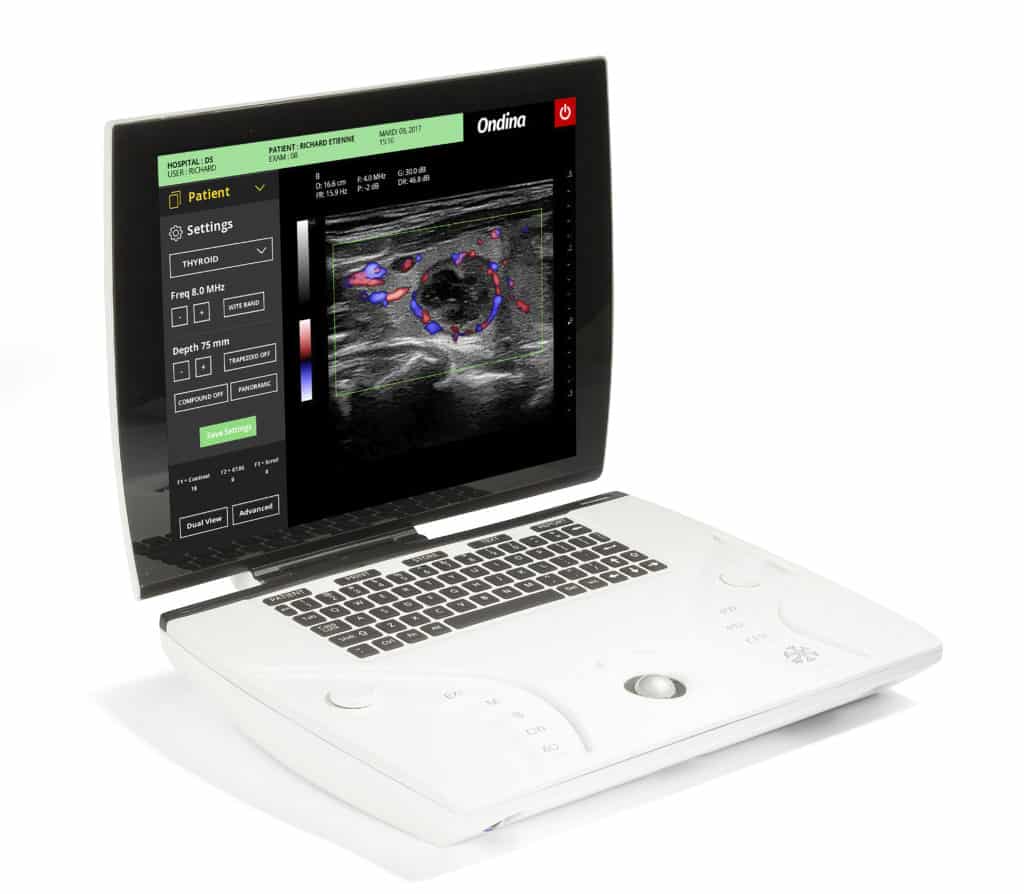
Ondina
Hybrid Portable Ultrasound Platform
15″ Full HD screen
Retina+ image quality
AI features
Hybrid use: touchscreen and keyboard
Fast startup: 20 seconds
Panoramic, elastography, and 3D/4D options
8 available probes
Automatic reporting



